Your Custom Text Here
Dino
The Adventure Begins: 2023
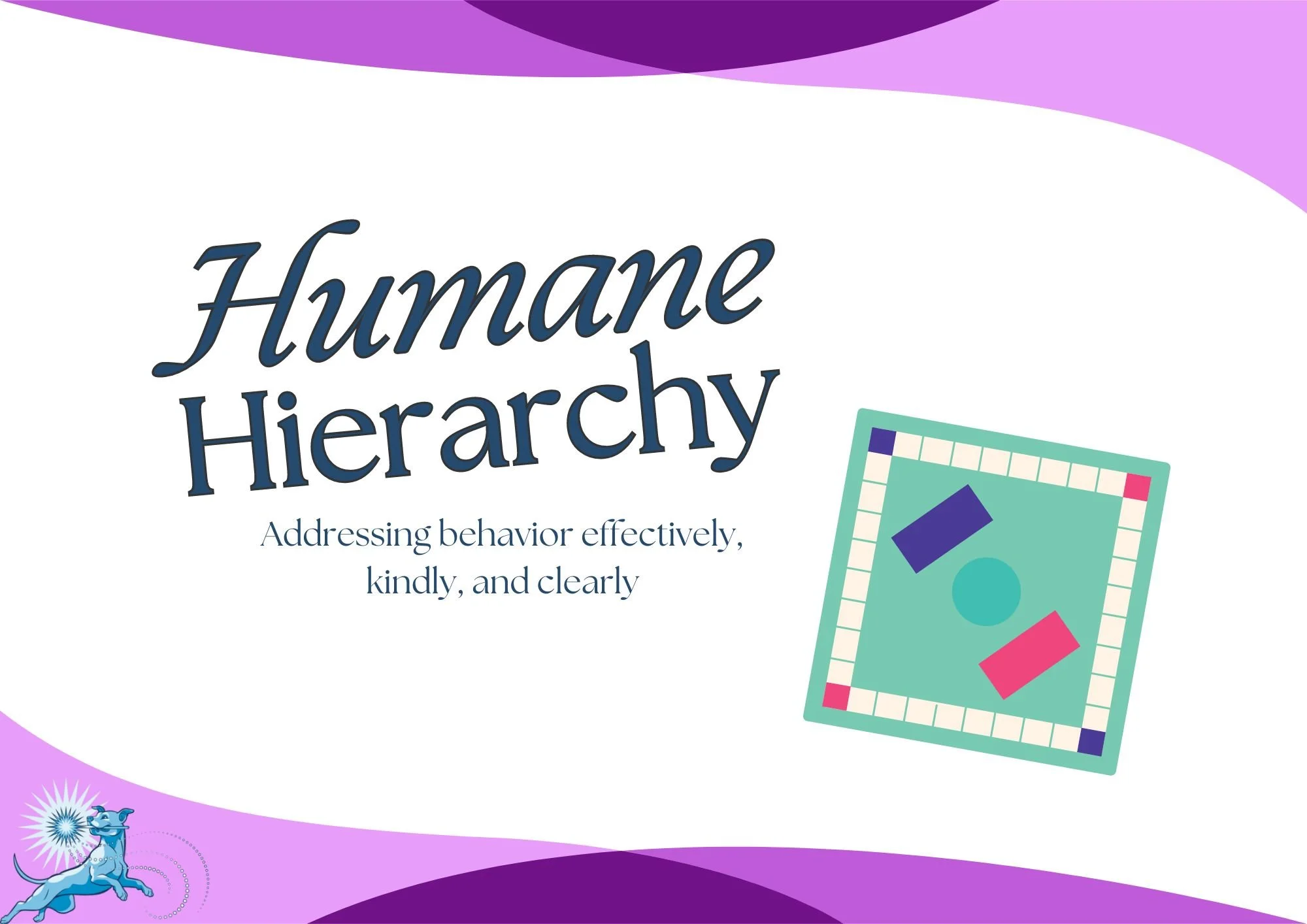
What is the Humane Hierarchy?
Addressing behavior from a professional lens means approaching change from a systematic and humane process. While you can read a little about my training philosophy on my Frequently Asked Questions and in this blog post, generally speaking when looking at behavior change I will recommend you review the Human Hierarchy of needs for your dog.
This structure emphasizes physical and mental welfare, and changing behavior by setting up successful interactions with positive reinforcement driving preferred behaviors. I am always cautious before including any behavior in a training plan that may exacerbate frustration or distress for your dog, and will work to avoid creating fallout and mistrust in your training program.
Coaching Resources
The more you utilize your coaching line and share questions and observations about your dog, the better I am able to structure sessions to meet your needs!
Guild Hall is a client portal within my website - you’ll find classes and events available only to past and present clients there, as well as discounts on certain future services. You’ll also find recommended outlets for your dog, including sports, events, and sniffspot information.
“Your Canine Community” is my client Facebook group - a spot where you can find folks also working on similar challenges with their dogs, ask questions and share resources.
Your google drive is available to you to reference your contract and contact and care form, make updates to your dog’s care information, upload vaccination records, as well as share videos and photos with questions or for feedback!
Scheduled Session Dates:
08/02-08/09: Board and Train (1 week)
Character Sheet
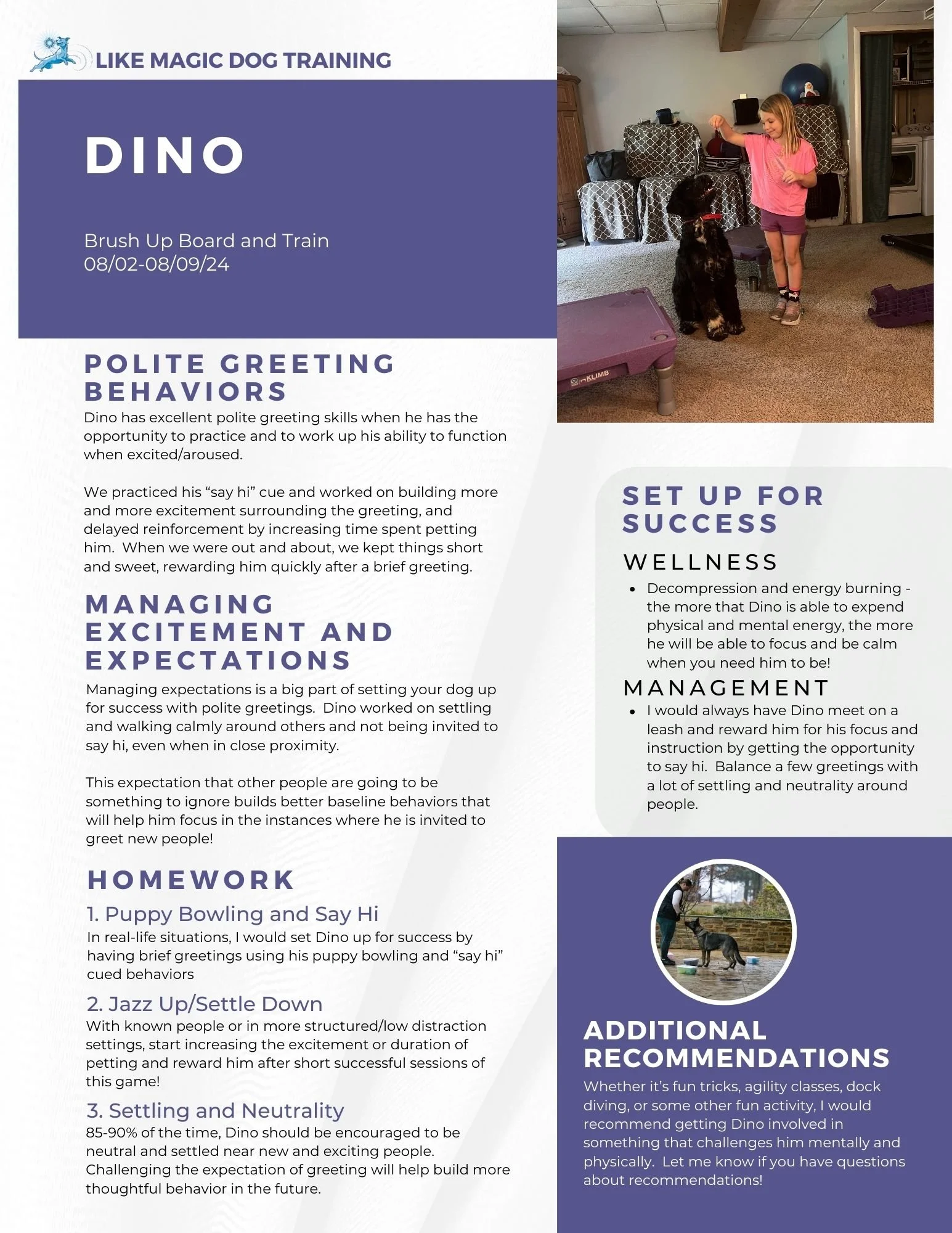
Skill Tree
08/02-08/09
Campaign Notes
07/03-07/08: Board and Train
Board and Train: 08/02-08/09
2023
〰️
2023 〰️
2023 Board and Train Resources
Jump Right to Behaviors:
Recall Games:
“Gotcha!” or Collar Gives
Begin with your puppy close by. Say "Gotcha!" reach out and grab or touch your puppy's harness or collar, and reward with a treat. They don't need to be pulled or lifted up, just mild restraint.
If your puppy ducks out of the way or plays keepaway at this point, put them on leash and do the same exercise, grabbing a point on the leash where your puppy isn't trying to avoid you. Slowly move up the leash until you can grab their collar or harness from any direction.
If your puppy is happily moving/leaning into your collar grab, you can start taking a few steps away, calling "Gotcha!" and holding your hand out for them to move into, as an informal recall.
Chase Me Games
Playing simple games that Dino is likely already familiar with, like “Ready- Get It!” can be a great way to get him excited and motivated for a recall. Having him practice passing you by rather than stopping just short of close to you can be a good way to remedy keepaway - especially if he’s not in an environment where he will be comfortable yet with Collar Gives.
Pass the Cookies
This is a game of distraction. With Dino in a wait, walk diagonally over to a bowl and pretend to drop a cookie in the bowl. Then walk again to stand in a straight line from Dino and call him to you. Keep encouraging him to you and reward him heavily if he chooses not to run to the bowl. Release him and run to the bowl and reward together.
Slowly move the bowl closer to the path he will be running through, and begin occasionally leaving food actually in the bowl - only when you can control getting to it first! We’re teaching Dino here that he can get both prizes, but only if he prioritizes getting to you first. If he prioritizes the bowl, he gets neither.
1-2-3
With Dino in a “wait” walk a few paces away from him. Start the game by getting into an exciting position and then calling him. Begin building anticipation by more duration before calling him, eventually counting “1…2…3” before using his recall word. Go slowly through this process, first getting into an exciting position and calling “3…COME!” and if he does well “2…3…COME” until you can count fully to three. If he breaks early, no consequences are needed, he doesn’t get rewarding and walk him calmly back to his spot and ask him again to wait. If he breaks more than once in a row, make the game a little easier for him by being less exciting or not counting so high.
This game reinforces both a solid, excited “wait” while building focus and anticipation towards you for an explosive successful recall. This is a good game to start incorporating collar gives outdoors because Dino is likely to be super excited to get to you. It’s also a great game to start to build cue discrimination - Dino has to listen specifically for the cue “Come!” - he doesn’t get a reward if he recalls on 1, 2, or 3.
Continue Building Skills:
All of these games build on each other, but that doesn’t mean I would only work 1-2-3 and forget the rest. Play each game individually during a session, or mix and match within a session to keep him excited. Solid recall happens when dogs are always enthusiastically reinforced for getting to you and staying with you, and set up for success in the process. Use a long line to keep him close by if you’re not certain he will be successful at a recall, and consider walking up the line if you think you’re too far away for him to pay attention. Starting one of these games rather than going into a recall “cold” can also help because he will have fun associations with playing the game!
Building a Stay:
Because we were working on recall and go to place as Dino’s other focus skills during this stay, I emphasized a “stay” and “wait” from a stationary position. There are different kinds of impulse control behaviors you can practice that can be lumped into a “stay” or a “wait” cue. The ones we focused on were:
Stay in the position I cued you to be in (a “sit” or a “down” usually) until I tell you to get up. This can be a cue for settling as well, and is typically what you want when you have your dog stationed on a mat. Because of this, we worked this kind of “stay” on the same mat we were building the mat behavior (below) on.
Stay in the position I cued you to be in (a “sit” or a “down” usually) until I release you to something. This can be a release to anything exciting for a dog - but I usually use a “wait” as a different cue for this because you get a different energy in the stationary behavior. Where “stay” as described in the bullet above is settled, “wait” here is anticipatory. For our “wait” see the motivation building in the “1-2-3” exercise in Dino’s recall video.
You also may want to consider building:
Stay still near a desired reinforcer (like a treat or a toy) and don’t take it until I say so. This is similar to the “wait” we practiced in recall - it’s anticipatory because the dog is primed for an explosive and rewarding release.
Come to a quick stop in the midst of exciting behavior - like stopping and waiting mid-recall, or stopping in the middle of a game of chase. This is an advanced skill because the dog is not coming into position in a calm and thoughtful manner but can absolutely be built off the wait and stay skills we focused on during his boarding stay.
Continue Building Skills:
I would recommend continuing with the Overall Relaxation Protocol that we started. Dino has done sessions through Day 5 with a few repeats, but there are 15 days of slowly building distraction, distance, and duration with a really solid stay.
When you play the recording for the day, ask Dino for a position (I prefer Down) and reward at the end of each “exercise” during the protocol - so if you’re supposed to count to 10, count to 10 and then reward. Release only at the end, and be careful to not release immediately at the end (Dino will start releasing at the video’s voice rather than your own!).
Loving the Mat:
The first thing we do in building a solid “place” cue is to build interest in the mat. You’ll see in both the example videos as well as Dino’s own training sessions that I’m starting with tossing treats across the mat and rewarding offered interest in the mat. The more he’s excited about the mat itself, the more likely he will be to be willing to leave me (who he knows has treats) to go to the mat. I want him to be really certain that the mat has great things in store for him.
Once Dino is consistently going to the mat and offering a down, I can give the behavior a name. In Dino’s case, I waited a little longer because I noticed he had a hard time going there from a distance. it wasn’t until he was reliably going to the mat even if I was a few steps away that I started telling him “Place” before he went over to the mat.
Your “stay” practice is going to give Dino great ability to hang out on the mat. What we spent a lot of our “mat” sessions on was the ability to go to the mat from anywhere in the room, with anything happening - so me talking, knocking on the walls, coming out of a recall, etc. I want to make sure that no matter where he is, he can go “place” and remain there.
Continue Building Skills:
Start small with this one - for the moment it’s going to be very contextual to the mat here in my basement. I would start with a new mat or bed at home with the same early steps of tossing treats across it. What you will notice is that the more mats you introduce from the beginning, the more quickly you’ll be able to progress to sending him from a distance to those mats. With enough introductions to different mats and different places, you’ll be able to point to a spot, tell Dino “place!” and he’ll run over and lay right down. Instant patio manners!