Alfie
The Adventure Begins: 02/19/2025
What is the Humane Hierarchy?
Addressing behavior from a professional lens means approaching change from a systematic and humane process. While you can read a little about my training philosophy on my Frequently Asked Questions and in this blog post, generally speaking when looking at behavior change I will recommend you review the Human Hierarchy of needs for your dog.
This structure emphasizes physical and mental welfare, and changing behavior by setting up successful interactions with positive reinforcement driving preferred behaviors. I am always cautious before including any behavior in a training plan that may exacerbate frustration or distress for your dog, and will work to avoid creating fallout and mistrust in your training program.
Coaching Resources
Start Here
〰️
Start Here 〰️
The Handbook is a lengthy read, but has just about everything you might need to know when starting a program. This is the absolute best place to start with your training package.
Start Here
〰️
Start Here 〰️
Guild Hall is a client portal within my website - you’ll find classes and events available only to past and present clients there, as well as discounts on certain future services. You’ll also find recommended outlets for your dog, including sports, events, and sniffspot information.
Character Sheet
Session Zero: 02/19/2025
Recommended Training Package:
Character Creation
Alfie has struggled with handling sensitivity and reactivity consistently since coming to his home at approximately 2 years old. Over the past year with his family he has dealt with a number of health concerns, and is finally feeling better and was neutered about a month ago. During neuter recovery, he did connect and puncture his owner when being carried down the stairs to go out.
It is likely that some of Alfie’s reluctance to be shifted or picked up is due to pain; he often chooses to stand over sitting, looks and feels tight near his hind end, and flinches when handled near his hindquarters. He also has intermittent limping in his rear. He is currently on cosequin and has responded to best to the “beginning” (heavier) dosages. Alfie has an upcoming appointment with a neurologist to continue to explore possible pain issues.
On walks, Alfie is reactive to dogs - as soon as they are visible he will freeze, oriented towards them, and will progress towards a larger reaction as they get closer. Indoors, curtains are closed currently, but likely would react out the window as well. He has had limited interactions with other dogs off leash, but they have generally not gone well after settling into his home.
Alfie’s people are in the process of moving from Gambrills to Gaithersburg - their new neighborhood is less dense, but also lacks a sidewalk and places to turn off to skirt around other foot traffic. There are also a number of trails between houses and a path around the lake in the neighborhood that will attract other walkers and their dogs.
Since Alfie’s IBD limits options for rewards, check with his vet about what we could feasibly use that is safe but maybe more novel to him than his kibble - whether that’s alternate kibble that’s just a little tastier, freeze dried proteins, or meats/cheese that would be an option for higher value rewards. I appreciate your willingness to work with some stomach upset fallout, but much like being picked up being connected to pain, behavior only progresses so much when the learner doesn’t feel good. I love that Alfie has solid food drive and want to make sure we make use of that - not make him decide training sessions end in a tummy ache.
Similarly, keep me posted on the neuro observations and any changes or updates with Alfie’s pain management. I do want to start building some cooperative care skills for him, but we don’t need to push forward until (as above) he’s feeling physically better, and I want to make sure I’m taking into account that physical stress as we add more activities.
I would highly encourage window film for the new house, on any windows that are going to face the neighborhood. These let in lots of light, tend to be very pretty in and out of the house, and are easy to put up - and easy to take down, if he gets to that point.
Beyond that, my priority would be to have him come out to the new neighborhood where possible to have great experiences. We have an opportunity for a clean slate, so the more we can load up on no reactions out and about, the better!

Additional Recommendations:
I would highly recommend checking out some accessible Sniffspots - especially ones where he can move around (look at some of the larger acreage spots if they’re within a reasonable drive for you) so Alfie can have some big decompression time as he gets settled in his new home.
02/19/2025
It was so nice to speak with you both and to hear more about your experiences with Alfie. He sounds like a complicated guy, and I’m hoping for you that this neuro visit will shed some light on some of the last health related questions about everything that’s going on with him and give you a solid path forward to making sure he’s able to feel his best.
In order to start introducing coping skills for Alfie, both for handling and care as well as reactivity, we focused on three skillsets during his initial session:
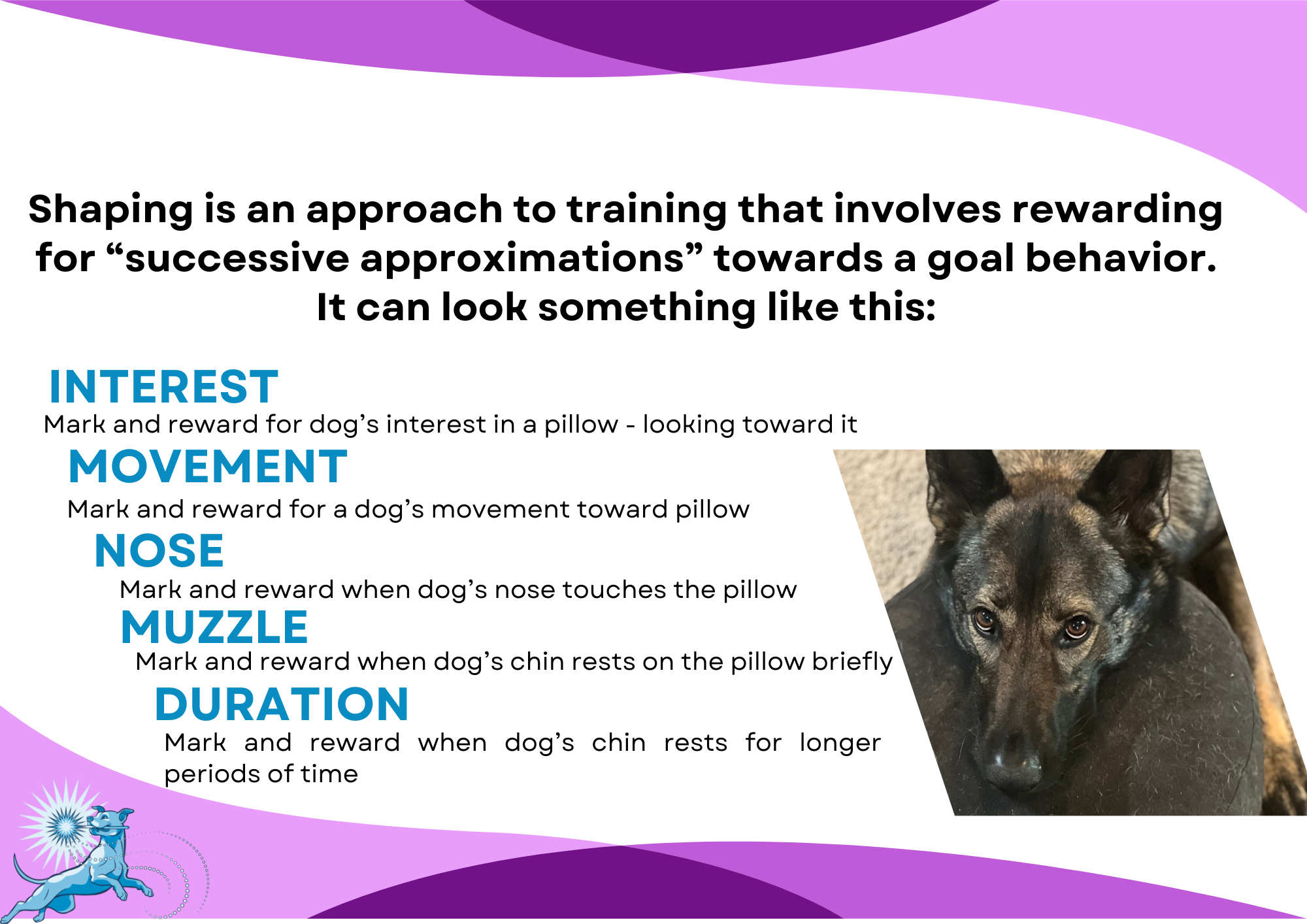
Building a chin rest: asking Alfie to rest his muzzle either on your hand or on a chair/cushion as is easier for him and for you to work on. Build duration for the behavior for now, and this will end up being utilized as a “start button” behavior for cooperative care (more below).
Utilize food scatters: At a distance where Alfie can respond to food, respond to the presence of other dogs by getting Alfie snacking on food in the grass, continuing to place more treats where Alfie has already eaten, creatin a “neverending” scatter.
Train a “Look at That” skill: We want to build Alfie’s ability to “note and report” a distraction - for right now, work on this in the house with benign distractions from the two of you - mark as soon as he looks towards the distraction (you’re rewarding for the stillness and lack of reaction from him even as he acknowledges his distraction) and place the reward so he has to turn back to you.
Cooperative Care is a great complement to reactivity training. Concisely, cooperative care is an approach to care tasks that includes teaching the subject to communicate their willingness to participate in their care - so in the case of a chin rest: Alfie lays his chin on the cushion, you can stroke his back, touch his ears or his mouth, lift his paws, even take his temperature or give an injection. When Alfie lifts his chin during care, all handling stops and we give distance. I highly recommend Deb Jones’ book “Cooperative Care: Seven Steps to Stress-Free Husbandry” as a resource for building Cooperative Care. She also has a Facebook resource group for questions during your training.
Since boarding is challenging for him, I would recommend going ahead with private sessions as a package for him - with the potential to re-evaluate down the line if that seems like it would be helpful. That said, keep in mind that if one of the things he’s struggled with boarding is acclimating to a new place, everything with the new house should progress slowly and deliberately, with a focus on All Good Things to make the transition as smooth for him as possible. The Character Creation package includes:
4 45-minute in-person sessions at your home*, a nearby park, or virtually
Recaps and Resources provided on your personalized webpage to keep you on track between sessions
Lifetime Access to relevant online training course
Everything that the client portal Guild Hall has to offer - including nearby classes and events, discounted services, additional troubleshooting and coaching, and more!
…$740
Since your home is likely outside my usual service area, we could work at a mutually convenient park and then move towards working at the new place; I do have a service fee associated with travel outside my area, but I think with most of the behaviors you’re looking to work on, we could do so at the park and then maybe cap it off with 1-2 sessions at your home to translate the behaviors into the neighborhood and troubleshoot there.
Let me know if that sounds like a good plan for you both, and if there’s any questions I can answer. Looking forward to working more with you and Alfie!
06/05/2025
It was great to reconnect and get a sense of how Alfie is adjusting post-move. I know this new environment brings new challenges, and I appreciate all the work you’re doing to help him settle in.
Recap from Our Session: Alfie is continuing to show sensitivity around handling, and we’re still likely dealing with pain as a contributing factor. His reactivity in the new neighborhood is understandably more intense given the increased presence of other dogs. That said, you’ve already made some great progress in applying our earlier work.
Key Training Focuses:
Food Scatters: You’ve been using these thoughtfully, especially before approaching high-stress yards. Keep these as your go-to when you need to create distance or decompress. Think of them as the “easy mode” response to the hardest triggers.
Ready, Get It: This is your next step up the ladder. It’s a cue to prep Alfie for a treat toss in the direction you want him to move. It gives him an active task to shift focus and physically move away from a trigger.
Look at That (LAT): This skill is still in progress. For now, let’s simplify: reward Alfie the moment he looks at a distraction. We want him to associate calm observation with a reward, even before he turns back to you. You can also begin to cue it (“Look at that”) before he looks out, but only when that feels helpful. We’ll revisit this again next time to solidify the behavior.
Handling Sensitivity and Communication:
You’ve built a nice chin rest behavior! Let’s expand that by starting to move your hands around his body while his chin stays down. If he lifts his chin, that’s his cue to stop – and it gets rewarded. He’s learning that he has agency: he can say “yes” or “no,” and you’ll listen.
For lap-handling: I like the approach you’re taking. Try pairing your lift with a question cue ("Want to go up?") and check for his response. Leaning in = proceed, tensing or leaning away = pause. Keep the process voluntary.
Ongoing Considerations:
Continue exploring higher-value food options that won’t upset his stomach. It’s important he enjoys training and feels good doing it.
Vet & Rehab Recommendations: You mentioned exploring additional support — here are some folks my colleagues have had success with:
Dr. Brunke at VRA (Gaithersburg)
Dr. Fink & Dr. Lotsikas at Skylos (Frederick/Marriottsville)
Dr. Corral at VRA (rehab/PT)
If he has any limping episodes, strange movements, or otherwise seems tense, definitely take clips of those and hold on to them - it will be helpful to bring in any examples that you’re seeing to a specialist.
Thanks again for all the thought and care you’re putting into Alfie’s progress. Keep me posted on any changes or questions — I’m always happy to tweak things as we go.
Consent Testing Example
More Cooperative Care
Cooperative Care with Chin Rest
Look At That - When to Let them Stare and When to Interrupt
Teaching an “Up” Cue by Association
09/23/2025 and 10/02/2025
Alfie did a phenomenal job at the farm park and showed a ton of progress — here’s a quick recap of what we worked on and what’s next.
🐾 Training Focus:
We introduced three new tools to help with leash handling and engagement:
1-2-3 Walking Pattern – to build rhythm and anticipation on walks
“This Way” Emergency U-Turn – for smooth direction changes when needed
Magnet Hand – a management skill for safely guiding Alfie in tight spots
Paired with “Ready, Get It” and “Look At That,” he worked beautifully around Fig. He handled the approach-and-retreat setup calmly and would be ready for slightly more challenging sessions next time — like closer approaches or tighter spaces.
💡 Handling Focus:
We talked about moving his chin-rest behavior from your hand (which he’s unsure about) to a pillow or leg for comfort.
You can also start jotting down small observations about handling to help guide future work — though it’s absolutely fine to pause that for now given recent events.
It was really good to connect and talk through everything that’s been happening with Alfie since that session at the park. I know the situation with the cat and the bite was stressful, and I really appreciate your openness and thoughtfulness in working through it.
It sounds like Alfie is already showing positive changes now that things have settled at home, which is great to hear. Here’s a quick summary and some next steps to help support his continued progress:
🍽️ Feeding & Management
For now, have Alfie in the yard or another room while you prepare his food.
Begin practicing his “place” behavior separately — make it a fun, enthusiastic exercise so that waiting calmly becomes a predictable part of mealtime.
Once that’s solid, you can start releasing him to his food as part of the routine.
🦴 Resource Guarding Protocols
Tossing treats away isn’t working effectively right now since he moves too fast. Instead, focus on that “place” behavior for clear structure.
When you need to move him away from something he shouldn’t have, it’s perfectly fine to walk up the leash and guide him instead of asking for a drop.
We also reviewed gentle, defensive handling techniques (looping the collar, twisting up for safety, and straight-arming the leash to prevent redirection).
🧠 Continuing Support
I’d recommend continuing our in-person sessions when possible and adding Cast Guidance for consistent feedback and video review between sessions.
It’s $65/month and includes:
Weekly office hours for coaching and Q&A
A monthly skill check
Up to 5 minutes of video review each week with personalized feedback
10% off classes and workshops
As always, I’m here to support you both as you continue building trust and structure with Alfie.
If you’d like to have it on hand, here’s the behavioral euthanasia resource we discussed — not because I think you’ll need it, but so you have all the information available should you ever want to revisit it for perspective or support.
Skill Tree